The Split Second
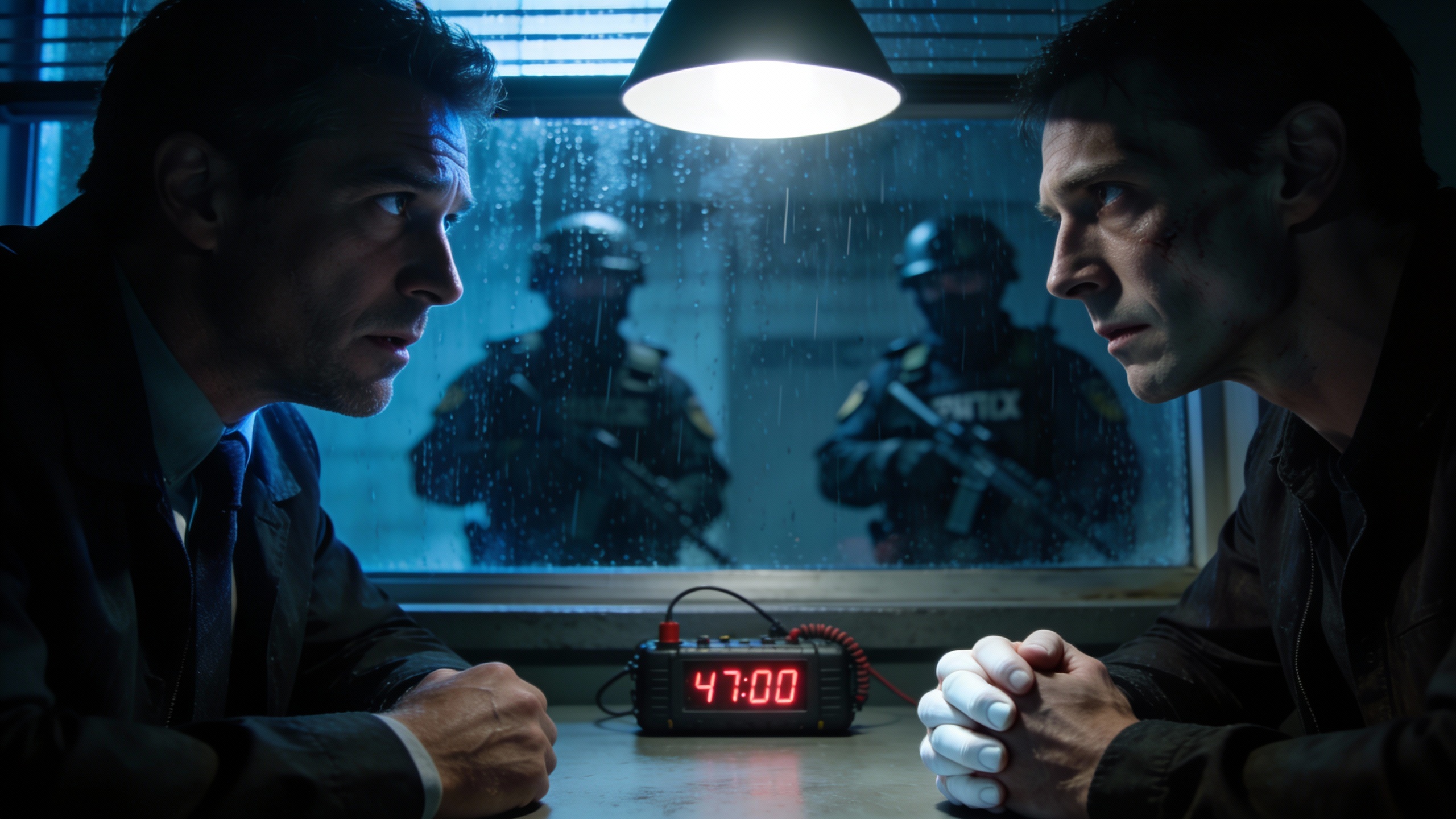
The rain hammered against the precinct’s windows like a metronome counting down to disaster. Detective Elias Voss adjusted his earpiece, the static hum of the comms unit a familiar comfort. Across the table, Daniel Mercer sat with his hands folded, fingers laced so tightly the knuckles had turned white. The man’s face was a mask of calm—too calm. Elias had seen this before: the eerie stillness of someone who had already decided how this would end.
“You don’t have to do this, Daniel,” Elias said, keeping his voice low, measured. The hostage—Mercer’s ex-wife, Lisa—was still alive, but the timer on Mercer’s phone ticked down from 47 minutes. The bomb vest strapped to his chest was real. The threat was real. But something else was off. Mercer’s pupils didn’t dilate when Elias mentioned Lisa’s name. His breathing stayed even when Elias described the SWAT team’s position outside. It was as if the man sitting across from him was only partially there.
Elias’s PAVIS feed flickered in his peripheral vision, a holographic overlay only he could see. The Emotional Intelligence module pulsed red.
PAVIS: “Subject’s vocal stress markers are inconsistent with stated emotions. Detecting compartmentalization—possible dissociation from the situation.”
Elias frowned. Compartmentalization. He’d read about it in the psychology briefings—how some people could split their minds into separate “compartments,” each handling a different reality. One part of Mercer was negotiating. Another part was already gone, detached, ready to pull the trigger.
PAVIS (Edge Engine): “Suggest probing the ‘other’ compartment. Ask about the hostage’s childhood—emotional trigger likely to bypass dissociation.”
Elias hesitated. This wasn’t just a negotiation. It was a minefield. One wrong step, and Mercer would slip into the compartment where Lisa didn’t exist. Where he didn’t exist.
“Daniel,” Elias said, leaning forward. “Lisa told me once about the summer you two spent at Lake Tahoe. She said you built her a treehouse. Remember that?”
Mercer’s fingers twitched. A flicker of something—anger? grief?—crossed his face before vanishing. The Shield Engine flashed a warning:
PAVIS: “Gaslighting attempt detected. Subject is suppressing memory. Suggest redirecting to concrete details.”
Elias’s pulse spiked. He’s lying to himself.
“You carved her initials into the railing,” Elias pressed. “L + D. She still has a photo of it on her phone.”
Mercer’s breath hitched. For the first time, his composure cracked. His voice dropped to a whisper. “That wasn’t me.”
PAVIS (Emotional Intelligence): “Subject’s voice stress spiked. Detecting cognitive dissonance—conflict between memory and current identity.”
Elias’s mind raced. Mercer wasn’t just compartmentalizing. He was erasing. The man in front of him had built walls so high, he couldn’t even see the parts of himself that loved Lisa. That was Lisa.
PAVIS (Planning Feature): “Goal update: Reintegrate subject’s fragmented self-awareness. Suggest using ‘mirroring’ technique—reflect his own words back to force confrontation.”
Elias took a slow breath. “You’re right, Daniel. It wasn’t you. Not the you sitting here now. But the you who built that treehouse? He’s still in there. And he’s screaming.”
Mercer’s hands trembled. The timer hit 30 minutes.
PAVIS (Edge Engine): “High-risk moment. Suggest immediate emotional anchor. Use the hostage’s voice.”
Elias nodded to the comms officer. A second later, Lisa’s voice crackled through the speakers—soft, pleading. “Daniel, please. I know you’re still in there. I love you. The real you.”
Mercer’s chest hitched. A single tear cut through the dirt on his cheek. The Shield Engine updated:
PAVIS: “Compartmentalization breach detected. Subject’s emotional barriers weakening. Proceed with caution.”
Elias didn’t move. He didn’t speak. He let the silence do the work, let Mercer’s own mind turn against the walls he’d built. The timer hit 20 minutes. 15.
Then Mercer’s fingers unclasped. He reached for the detonator—and stopped.
“Turn it off,” he whispered.
The bomb squad moved in. Lisa was safe. Mercer was in custody.
But as Elias watched the ambulance lights fade into the rain, he knew the real battle wasn’t over. Some compartments never stayed closed.
And neither did the men who built them.
---
For more on the psychology behind high-stakes conversations, read The Therapist’s Labyrinth: When the Mind Becomes Its Own Worst Patient.